
Sometimes that guy talking too much during a movie deserves a salute rather than a dirty look.
That’s why Milwaukee Record’s Matt Wild published an unironically grateful piece on April 18 called “11 things the guy behind me yelled at last night’s midnight screening of ‘A Bay of Blood.’” His rundown is hilarious, but naturally raises the question: Who was this anonymous guy having way too much fun—or maybe just the right amount of fun—at this year’s Milwaukee Film Festival?
Mystery solved, folks. Turns out the solo filmgoer whose infectious enthusiasm captured Wild’s imagination is none other than Peter Ross, a 41-year-old chemotherapy specialist who was born in West Allis, grew up in West Bend and now lives in Greenfield. Despite being an avid cinephile (his favorite movie is David Cronenberg’s “The Fly”), he had never attended the Milwaukee Film Festival until this year. But if prizes were given for Best First Fest, Ross would be a frontrunner.
It all started on opening night, with the world premiere of “Ueck” at the Oriental Theatre.
“I picked up a festival guide from Volta Records and saw that the Bob Uecker documentary was playing,” said Ross, a major Brewers fan. “It was sold out, so I decided to go down and try my luck in the standby line, and unbelievably, myself and three other people got in.”
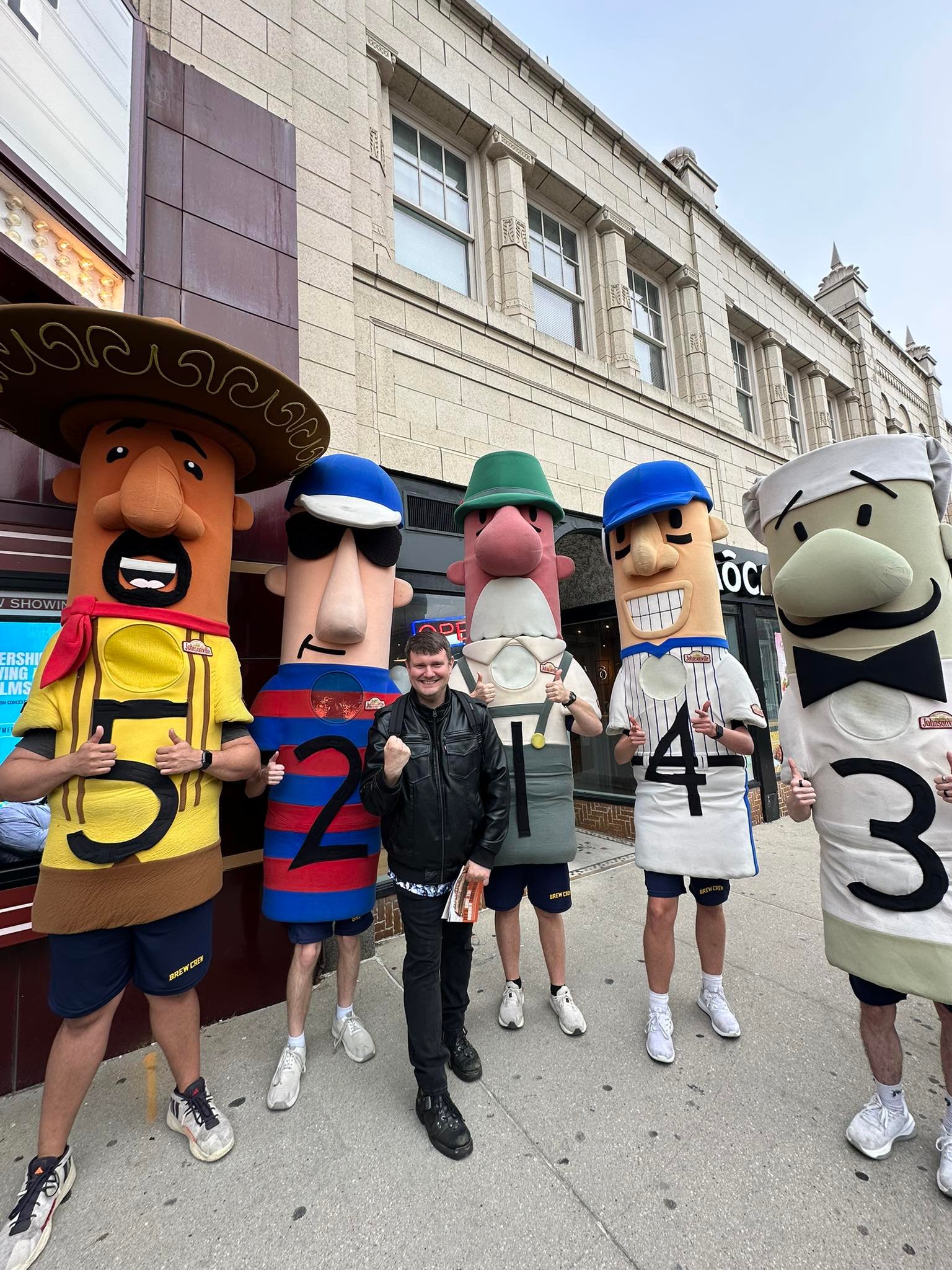
While waiting on the sidewalk where he was first in line, Ross saw the Famous Racing Sausages arrive in a large van to help present the new nonfiction film about the beloved Brewers broadcaster. A few maneuvers later, he was posing with the mascots and ended up featured in the event’s official photos.
Ross continued notching lucky breaks throughout the festival. By the time the 15-day event ended on April 30, he had seen 12 films, secured another standby success, attended closing night and even taken a selfie with Adam Moskowitz, star of the centerpiece film “The Big Cheese.”
“I asked him what kind of cheese someone like me, who doesn’t like it, should try to see if it’ll change my mind,” Ross said. “He recommended aged Gouda.”
Yet the highlight was Milwaukee Record documenting for posterity his rowdy enjoyment of “A Bay of Blood,” Mario Bava’s 1971 giallo classic.
“My initial reaction upon seeing the headline was, ‘A lot of people were yelling things. Was it me?,’” Ross said. “When I read the article and saw the 11 things he’d written down, I shook my head in a combination of disbelief and amazement and said, ‘It WAS me!’ I couldn’t help but laugh, and I posted it to my Facebook feed and told my friends and family about it.”
For Ross, it was a no-brainer to become a Milwaukee Film member for the discounts on tickets, merch and concessions, but he says it’s also “fantastic” that his dues will help maintain the historic Oriental and Downer Theatres. He’s already anticipating next year’s MFF.
“Every day I made it to the festival, everybody I met was having fun, buzzing about the movies they’d seen or were about to see, and I felt the good vibes everywhere,” Ross said. “The height of it was the ‘Stop Making Sense’ screening. It felt like an actual concert with everybody, myself included, singing and dancing in the aisles. I had an absolute blast.”
Best of fest
There was, indeed, something transcendent about MFF’s traditional showing of the Talking Heads concert film—I was up and dancing, too—and of the 51 new features I saw at this year’s festival, only one prompted a similar sense of levitation.
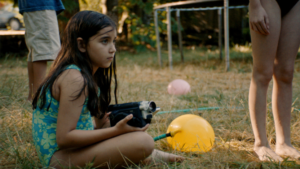
I stayed in my seat, of course, but what’s left of my hair stood on end during the final passages of “Blue Heron,” Sophy Romvari’s semi-autobiographical drama about a Hungarian immigrant family of six coming to Vancouver Island in the 1990s. What appears to be a compendium of mundane, impressionistic fragments—Maya Bankovic’s cinematography sees the beach, a trampoline and chalk games the way a curious child might—eventually proves to be a series of carefully plucked pieces of shrapnel. What is the long-term fallout from living with a troubled loved one? Romvari bypasses the usual platitudes about grief, guilt and nostalgia, conveying instead a distinctly personal way of feeling. After a startling time jump, “Blue Heron” unfurls those emotions by brilliantly folding in on itself and boldly merging fiction, memory and art to create a crushing wave of understanding and forgiveness.
The rest of the best

Mirrors play a pained, fracturing role in “Blue Heron,” but at least we can see a glimmer of healing. All that’s reflected in Nadav Lapid’s provocative satire “Yes” is disintegration. As an Israeli couple capitulates to every decadent whim of their nation’s ruling class, Lapid presents a soul-sick society in rapid decay. By turns frenzied, unhinged and wrenching, this maximalist black comedy is conspicuously about Oct. 7 and the director’s view that disillusionment can easily curdle into debasement. Still, there’s a universal relevance in the visceral, physical way Lapid challenges what it means to live normally while horrors unfold in real time. At one point the camera begins to turbulently shake, and the overwhelming nervous energy matches how even Americans feel while reading the headlines each morning.
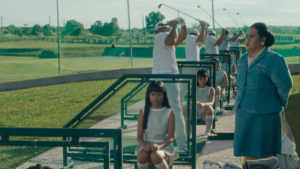
If “Yes” is a feverish indictment of nationalism, Rafael Manuel’s “Filipiñana” is its equally repulsed yet much quieter cousin, a narcotized critique of colonialism and exploitation. Set on a ritzy golf course near Manila that is rife with shadowy secrets, this surreal drama has the shape of a musical—characters move in such choreographed harmony that they often seem on the verge of breaking into song and dance—but the colorful, symmetrical tableaux are instead used to suppress any sense of escape. That explains Manuel’s decision to use the boxy 4:3 aspect ratio rather than, say, the widescreen ‘Scope familiar from classic MGM musicals, and it signals why he owes far less to Gene Kelly than to Jacques Tati and especially Jia Zhangke, who executive-produced and whose own work similarly fixates on new economic realities and the erasure of the past.
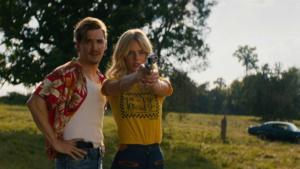
Anyone who’s seen “Paper Moon” will be instantly wise to the dollar con that opens “Carolina Caroline,” a sizzling, countryfied version of other grifter-protégé movies like “Matchstick Men” and “Focus.” On paper, much of Adam Rehmeier’s tale of outlaws on the run seems routine, but in practice, it carries a rare mainstream charge. This is partly because Rehmeier gives the movie a burnished, sweaty, thrift-store look—I thought of “Something Wild” and “The Sugarland Express”—but mostly because Samara Weaving, playing a sweet, desperate, dangerous fugitive with Goldie Hawn’s hair, isn’t afraid to go big. Weaving has been on the cusp of superstardom for a decade now, and by the end of “Carolina Caroline,” it looks like both Caroline and Weaving are finally poised to conquer the world.
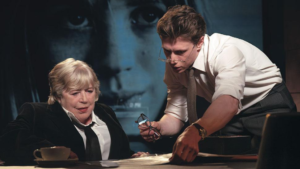
The camera also loved Marianne Faithfull, the bohemian rocker whose husky voice and iconic fashion sense were pillars of the 1960s British Invasion. What’s notable about “Broken English,” a fresh documentary about Faithfull’s life and career, is how fully it also embraces an unorthodox style, inventing a distinctive delivery system for its assemblage of facts, reflections and resonances. Playing functionaries at the fictional Ministry of Not Forgetting, Tilda Swinton and George MacKay attempt to reconcile the public record with Faithfull’s memories, which are shared through new interviews. Not everything works—some of the roundtable discussions feel forced, for example—but the experiment largely pays off, and Faithfull’s climactic recording session with Nick Cave and Warren Ellis is both beautiful and devastating.
Where to find them
“Blue Heron” screens Friday through Sunday at the Downer Theatre as part of Milwaukee Film’s Best of Fest program. “Yes” arrives on streaming services Tuesday, while “Carolina Caroline” begins a limited theatrical run June 5.
Five Favorite Films at the 2026 Milwaukee Film Festival
- “Blue Heron” / dir. Sophy Romvari, Canada
- “Yes” / dir. Nadav Lapid, Israel
- “Carolina Caroline” / dir. Adam Rehmeier, USA
- “Filipiñana” / dir. Rafael Manuel, the Philippines
- “Broken English” / dirs. Jane Pollard and Iain Forsyth, UK
Comments
Critic Speak uses Disqus for comments. Loading Disqus connects your browser to Disqus and may allow Disqus to collect device, activity, and cookie information under its own privacy policy.
Read the Privacy Policy